← Back to Mango Demo Site

📋 Stakeholder Portal

Business plan, market research, explainer articles, media, and contract templates — everything for investors and partners.

The Opportunity at a Glance

A side-business-scale AI consulting service for local retail and service SMBs.

$9,500

Month-6 MRR Target

10 active clients × $950 average retainer. Setup fees recognized over first 3 months.

60–75%

Target Gross Margin

Before owner draw — driven by productized scope and ≤3.5hr/client/month labor discipline.

1.9–3.2M

Addressable Businesses

Of 6.4M U.S. small employer firms, those in practical retail/service categories suitable for this model.

$400–$2,500

Monthly Retainer Range

Four productized tiers from Launch to Managed AI Desk, each with one-time setup fees.

Strategic Positioning

"We help local shops use practical AI tools safely and profitably, with in-person setup, staff training, and monthly optimization in plain English."

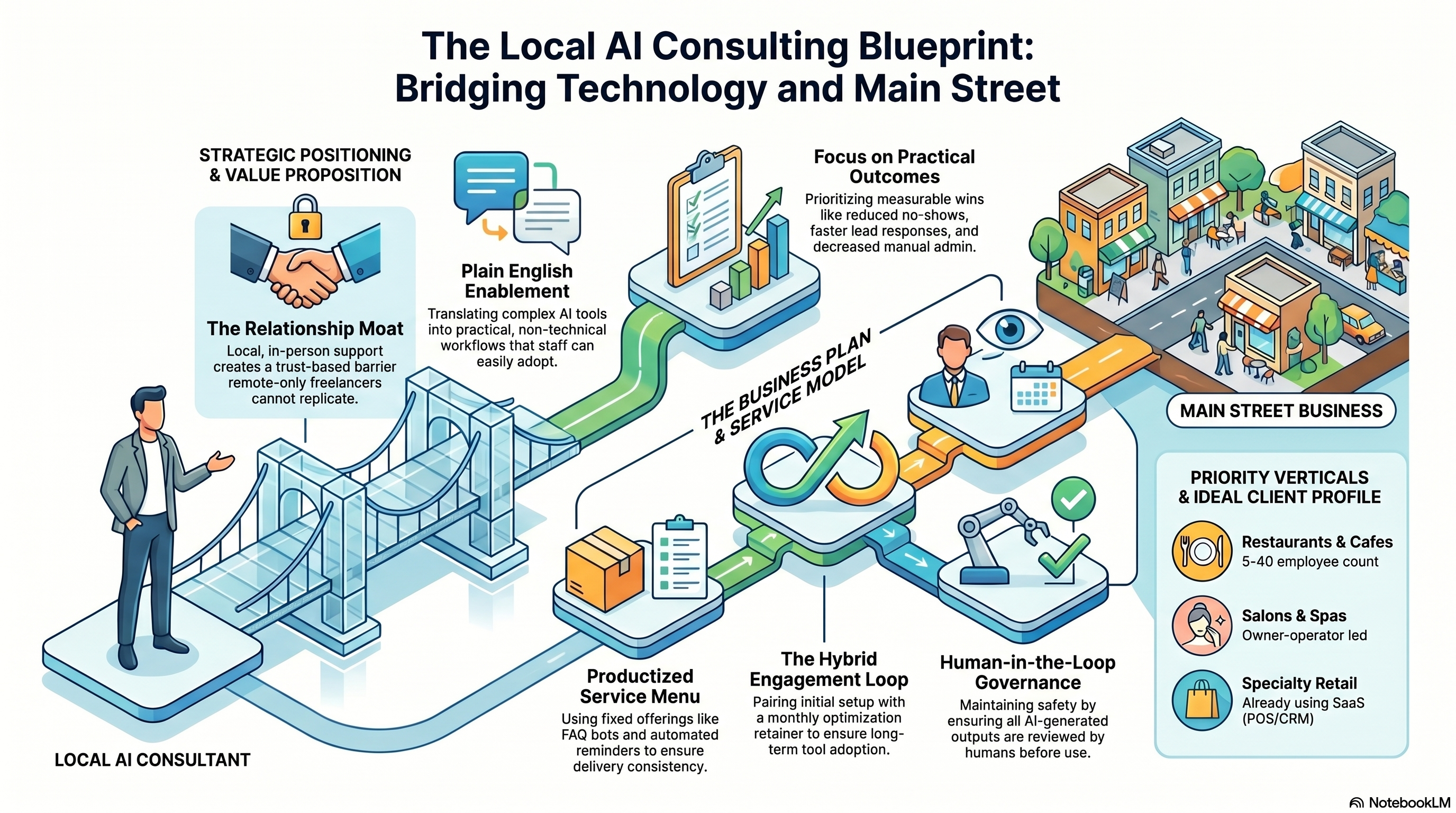
Small businesses report meaningful AI interest/adoption, but usage maturity varies by definition and technical confidence. DIY tools are improving quickly; pure setup work will commoditize. Local, relationship-driven enablement is harder to replicate than tool configuration alone.

Ideal Client Profile

  • 5–40 employee retail/service businesses, owner-operator led
  • Already using POS/CRM/accounting SaaS — no paper-only ops
  • No in-house IT/automation specialist
  • Monthly software spend tolerance ≥ $300

Priority Verticals (First 6 Months)

  • Restaurants & cafes
  • Salons & spas
  • Boutiques & specialty retail
  • Home/local service shops with appointment workflows
Full Business Plan

The complete operational blueprint: offers, pricing, acquisition, retention, unit economics, and 90-day execution plan.

Hybrid pricing: one-time setup + monthly retainer. Setup fee protects cash flow; retainer captures recurring optimization value.

  • Launch ($400/mo + $750 setup): 1 use case, 1 integration, staff training, monthly 30-min check-in, 48hr email SLA
  • Core Ops ($900/mo + $1,500 setup): Up to 3 use cases, monthly KPI report, optimization session, documented SOPs, 24hr SLA
  • Growth ($1,500/mo + $2,500 setup): Up to 5 use cases, quarterly roadmap, prompt library, vendor management, same-day support
  • Managed AI Desk ($2,500/mo + $4,000 setup): Cross-workflow orchestration, biweekly optimization, advanced governance, incident-response playbook, priority support

No-custom-code rule. Only sell from a fixed menu in first 90 days:

  • FAQ/support chatbot configuration
  • Appointment/no-show reminder automations
  • Review response drafting workflows
  • Basic inventory/expense categorization workflows
  • Internal staff knowledge assistant from approved docs

Guardrails: No bespoke app development. No model fine-tuning. No regulated/high-risk decision automation without explicit controls.

Channels: Local networking (chamber, BNI), referral partners (bookkeepers, MSPs, POS resellers), vendor directory profiles, targeted outbound (20 businesses/week).

Funnel: Free 20-min workflow audit → Paid quickstart ($300–$500, applied to setup) → 90-day outcome plan at proposal stage.

Every client gets: Monthly KPI card (3–5 metrics), quarterly "before vs after" savings summary, quarterly staff retraining, tool stack waste review.

Required KPIs: Response time reduction, lead conversion lift, no-show reduction, hours saved per week.

Average retainer (first 10 clients): $950/mo. Average setup: $1,750. Labor target: ≤ 3.5 hrs/client/month after month 2.

Month-6 target: 10 clients × $950 = $9,500 MRR. Gross margin: 60–75% before owner draw.

Days 1–15: Finalize offers, create SOPs for 5 service workflows, draft MSA/SOW, build CRM pipeline.

Days 16–45: Run 20 discovery meetings, close first 3 clients with Launch package, document time per step.

Days 46–75: Launch 3 referral agreements, publish 2 local case studies, test upgrade path.

Days 76–90: Reach 6–10 clients, review margins, kill/trim over-scope services.

Continue if by day 90: ≥6 active clients, ≥65% gross margin, ≤4 hrs/client/month labor, ≥80% 90-day retention.

Rework if any two fail: Pricing too low, recurring value unclear, acquisition too expensive/slow.

Minimum controls: MSA with liability limits, SOW with explicit out-of-scope, client sign-off on human-owned decisions, no guaranteed performance claims, AI error incident log.

WOSB plan: Submit certification through MySBA, prepare capability statement, pursue municipal/school/agency contracts where local presence matters. Federal 5% contracting objective.

Deep Research

Competitive landscape, market sizing, adoption data, pricing benchmarks, and risk analysis.

Key Findings

AI Adoption Snapshot

  • SBA (BTOS): 7.6% used AI over Sept 2024–Aug 2025
  • NFIB 2025: 24% currently using AI tools
  • U.S. Chamber 2025: 58% using generative AI
  • Census BTOS: 3.7% → 5.4% (Sept 2023 to Feb 2024)

Adoption is accelerating, but percentages vary because definitions differ (GenAI usage vs. AI in production operations).

Competitive Landscape

  • Local consultancies: TitanWave ($2K–$8K/mo retainers), NisonCo ($150–$250/hr)
  • Franchise/MSP models: CMIT Solutions, WSI adding AI to menus
  • Vendor ecosystems: Square, Shopify, HubSpot, Tidio building partner directories
  • Freelancers: Upwork AI engineers at $35–$60/hr create price pressure on setup
  • MSPs pivoting: ConnectWise, Pax8 moving to "managed intelligence"

Risk Factors

  • FTC actively enforcing deceptive AI claims (Operation AI Comply, Workado orders)
  • State AI regulation fragmented (Colorado SB25B-004 timeline extended to June 2026)
  • Commoditization of basic setup tasks is the highest commercial risk

Articles

Written explainers for stakeholders, partners, and prospective clients.

The "2 AM Inventory" Hook: You opened your boutique or bistro because you wanted to curate the perfect collection or bake the best sourdough — but now you're an unpaid data entry clerk for an iPad. You don't want a digital overlord; you just want your Tuesday afternoons back.

The Relationship Moat: As generic AI tools become commodities, your local, trust-based enablement becomes your unfair advantage. You need a partner who understands that showing up in person to train your staff is a revolutionary act.

Automate the Grunt Work, Keep the "Gut": AI is a very fast, very obedient intern who doesn't mind spreadsheet drudgery. Standardized services — FAQ bots, no-show reminders, review drafting, knowledge assistants — focus on workflows that actually move the needle.

The "Goldilocks" Pricing: Hybrid model (setup + retainer) ensures your tech doesn't become "abandonware." Start at $400/mo and scale as you grow.

Human in the Loop: We treat our safety model like a fire extinguisher for when the AI gets creative with your refund policy. You stay in the driver's seat.

Conclusion: The future belongs to the "augmented" owner who shifted time from low-value admin to high-value craft. Stay human. Stay local.

Local trust beats remote skills: A local consulting team possesses a "relationship moat" built on physical presence and localized trust. Choosing to show up in person is a calculated strategic move that eliminates the "low-commitment churn" plaguing remote implementations.

Practical beats profound: In the local economy, a "boring" automation saving three hours of admin is infinitely more valuable than a "profound" custom AI build that might break next week. The ideal clients — salons, cafes, boutiques, service shops — value repeatable workflows providing immediate relief.

The adoption paradox: 58% of businesses are "playing" with generative AI, but only 7.6% have integrated AI into production operations. Most are AI-interested but lack the confidence to move into "usage maturity."

The 90-day sprint: Days 1–15: finalize offers and SOPs. Days 16–45: run 20 discovery meetings, close first 3 clients. Days 46–75: establish referral agreements, publish case studies. Days 76–90: scale to 6–10 clients.

The translator, not the technician: The era of the technician who simply plugs in a bot is fading. A new class of "translators" wins not by having the most complex code, but by being the bridge between high-tech promise and high-street practicality.

The death of set-and-forget: Because DIY tools improve so rapidly, the act of "setting up" a tool is a race to the bottom. The real margin lies in recurring optimization — monthly KPI reporting, quarterly staff retraining, and constant updates on how new features solve old problems.

The Human-in-the-Loop legal shield: The FTC is actively targeting deceptive AI claims. Consultants who offer a "Managed AI Desk" with incident-response playbooks provide more than tech — they provide necessary insurance.

The WOSB advantage: With a 5% federal contracting objective for WOSBs, local consultants can combine in-person trust with official credentials to win government set-aside contracts that larger firms overlook.

Conclusion: The future will be defined not by the tools themselves, but by the people who translate those tools into human value. Is your business focused on the "tool" or the "trust" required to make the tool work?

Video, Audio & Documents

Explainer video, podcast-style briefing, and the full research PDF.

🎬 Local AI Consulting — Explainer Video

A video overview of the Mango consulting model, market opportunity, and service approach.

🎙️

🎧 Main Street AI Blueprint — Audio Briefing

Podcast-style deep-dive into the full business blueprint and strategy.

📄 Main Street AI — Full Research PDF

Can't see the PDF? 📥 Download PDF

Contract & Proposal Templates

Ready-to-customize MSA, SOW, and proposal templates for client engagements.

📋 Master Services Agreement (MSA)

Full legal template covering scope, liability, AI terms, IP, data protection, and termination.

📥 View Template

📝 Statement of Work (SOW)

Project-level scope, deliverables, timeline, success metrics, and AI-specific acknowledgments.

📥 View Template

💼 Proposal Template

Client-facing proposal with goals, recommended package, timeline, investment, and acceptance.

📥 View Template

Business Model Infographic

The Local AI Consulting Blueprint: Bridging Technology and Main Street — infographic showing strategic positioning, service model, ideal client profile, and governance approach